Montreal researchers have found a way to make electronic conductors with squid ink
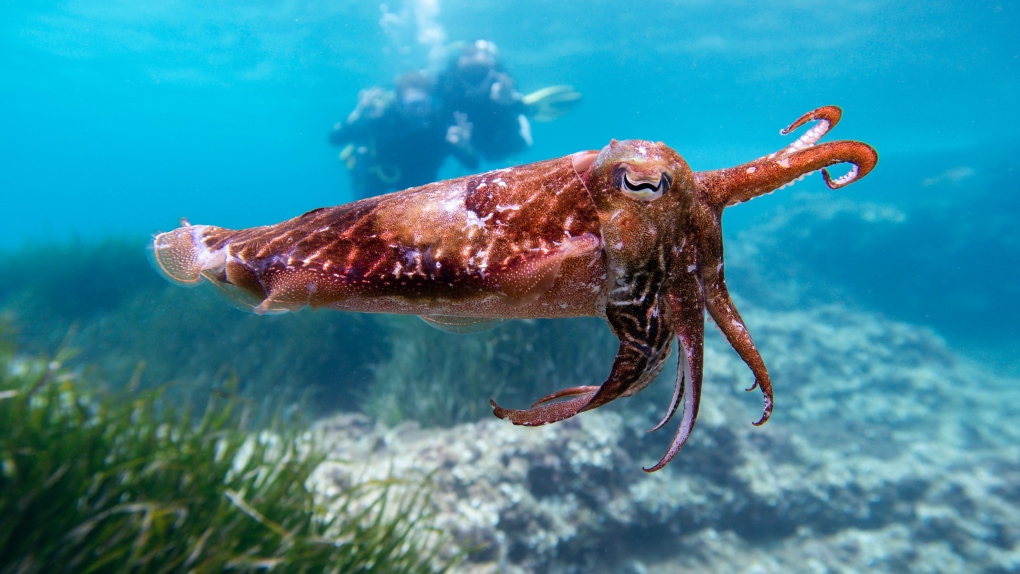
Montreal researchers are trying to reduce the environmental cost of electronic components, thanks to squid ink. Cuttlefish materials could be used to imprint melanin, which serves as an electrical conductor.
A Quebec team has developed a process to print melanin purified from squid ink. They published an article in the American scientific journal “Proceedings of the National Academy of Sciences” (PNAS).
The use of biosourced materials – derived from living organisms – in the world of electronics makes it possible to envisage a different end of life for these objects.
They could then go the compost route, rather than ending up in recycling centers or landfills.
“You have to be careful because there are criteria to meet for compostable materials, but there is a good chance that it will be biodegradable and even biocompatible,” said Professor Clara Santato of the Department of Engineering Physics at Polytechnique Montréal.
Indeed, beyond the use of biosourced materials, Santato wishes to highlight the fact that it is possible to use electronic waste.
“I think we have to open our minds and think that trash doesn’t exist,” she said. “Waste is only one stage in the life history of a material.”
While squid ink, which contains a lot of melanin, was used for the study, other perspectives are possible. For example, in the food industry, an insect farm contacted her to see if their melanin-rich residues could be used to make electronic components.
While it’s been known for about 40 years that organic molecules can conduct electricity, environmental concerns have led researchers to look at bio-based materials, which could be found in waste in particular, Santato said.
“This (waste) material is already available, so I don’t need to go to a chemical industry to synthesize it,” she added.
CONDUCTIVITY RECIPE
Another reason why melanins, brown-black pigments made up of rings of carbon atoms, have been little used so far: their lack of solubility, which makes the material difficult to process.
The Polytechnique team, in partnership with the Institute of Graphic Communications and Printability, has succeeded in overcoming this problem with a recipe that makes the melanin in squid ink soluble.
With a few ingredients and a binder, this mixture, once printed, forms a three-dimensional conductive network that can be used in electronic components.
It is the nanogranules of melanin, derived from squid ink, which allow the transmission of electricity.
“Paradoxically, our interest in the development of technologies helped us in the fundamental,” said Santato.
Indeed, these years of work on melanins have led to a discovery on the conductivity of organic molecules.
“This is one of the first times that a bio-based organic material has carried electrons and not ions,” she said, noting that there is no absolute first time, as research s builds on prior knowledge.
BIODEGRADABLE SENSORS
“It’s not that in five years microprocessors will be organic,” Santato said. “But there are plenty of applications for which we can think of moving towards something more respectful of the environment, such as sensors in the oceans, where we cannot collect at the end of their life. “
She cites, among other things, humidity and temperature sensors, oil loss sensors from boats.
“You can’t tackle these sensors afterwards, so you have to design them in a degradable way,” she said.
Later, she thinks it will be possible to develop chemical sensors and perhaps devices and integrated circuits. However, it specifies that for functions where speed is desired, silicon and inorganic materials will always prevail for reasons of chemical bonding.
“In other cases, organic (materials), because they are degradable, because they are flexible, because they can be printed – not like silicon – will have their share,” she said. declared.
Only downside for now, the binder used – polyvinyl butyral (PVB) – is not biodegradable. The team of researchers is nevertheless working to find an alternative that will allow an entire electronic component made from squid ink or other biosourced materials to end its life in the compost.
Other families of molecules are also studied, such as tannins for the electrochemical storage of energy and chlorophylls, which were analyzed in the 1970s and 1980s, in particular for their use in solar energy.
“We have more knowledge and sophisticated equipment in 2022 than in 1980. We can arrange molecules much better than 40 years ago,” said the professor.
She hopes that “waste” from the forestry industry, particularly in Quebec, can be used to produce electronic components.
This report from The Canadian Press was first published in French on August 13, 2022.